As joint sponsors of the 2026 Modeshift Convention, Citisense and Turvec share a common goal: helping organisations make informed decisions that work for the people they serve. Whether that’s through high-quality cycle parking infrastructure or robust transport data and analysis, both organisations recognise the value of practical solutions backed by evidence. Here, Citisense examines how quantitative and qualitative insights can work together to support successful School Street projects.
United by Evidence: How Data and Community Build the Case for School Streets
Ask anyone who has delivered a School Street, the hardest part was never the final implementation. It was the parent worried about where traffic would go, the resident concerned about their journey to work, the school governor asking whether the scheme would make a difference, or the person who felt their experience was not reflected in the numbers.
School Streets are about more than removing cars from the school gate. They change how people experience their streets, which means building understanding and confidence alongside the physical intervention.
That is at the heart of our session at this year’s Modeshift Convention: From Evidence to Understanding: A Framework for Winning Communities Over. We will explore how data and community insight can work together to build stronger, more trusted transport projects.
Data doesn’t win the argument on its own
At Citisense, our work on School Streets across London and beyond has made one thing clear: collecting good data is only the beginning.
Traffic counts, air quality monitoring and journey time data can tell us what is happening, but not always why people feel the way they do. That is where qualitative evidence matters.
Vehicle volumes may reduce while parents tell us children feel more comfortable walking to school. Air quality may improve while concerns about congestion remain. Surveys can also reveal fears about traffic displacement before they become a wider issue.
No single form of evidence tells the whole story. The value comes from putting them together. Instead of asking communities to simply accept what the data says, we can use evidence to answer the questions they actually have.
From consultation to collaboration
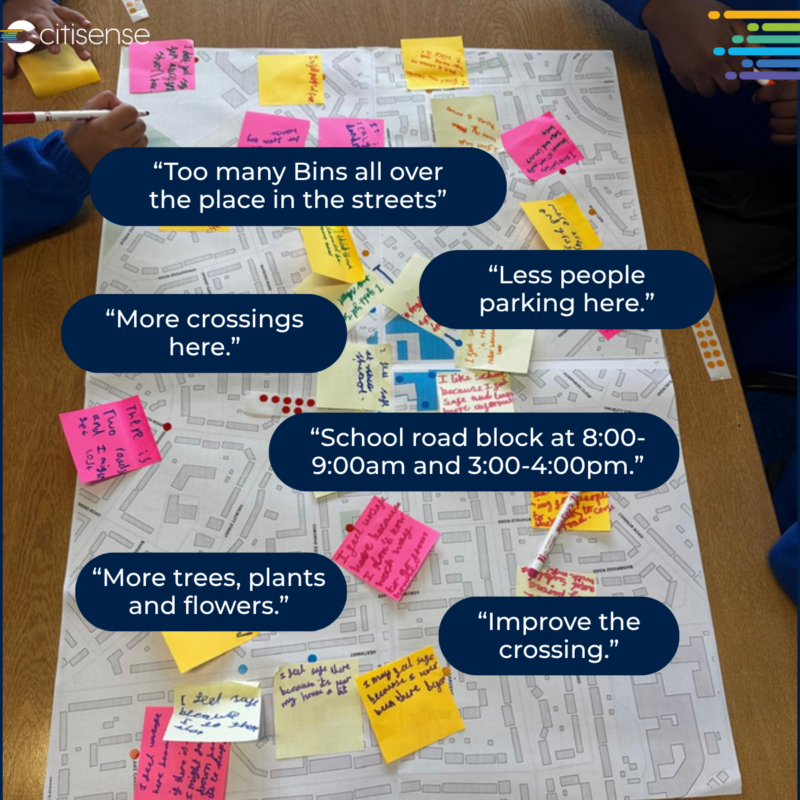
Too often, consultation is treated as a single stage: design the scheme, consult, make a decision and move on. Stronger projects create a feedback loop throughout intervention.
That means listening before implementation, understanding concerns as they emerge, testing them against evidence, explaining what it shows, and being prepared to adapt where it points to a better solution.
It also means recognising who isn’t in the room. Some voices are easier to capture than others. Parents who complete an online survey are visible, as are people who attend a public meeting. But what about SEND families, people with mobility needs, those who do not speak English as a first language, or people whose experiences and concerns are not easily captured through traditional data collection?
Good engagement isn’t simply about getting more responses. It is about making sure the evidence reflects the people who experience the change.
The power of the team
This is where the theme of Modeshift United really resonates with us. No single organisation has all the answers. Transport teams bring technical knowledge, schools understand their communities, residents bring lived experience, while engagement and data specialists help ensure different voices and perspectives are reflected.
The strongest projects bring these perspectives together early.
This matters even more when School Streets move from individual schemes to wider programmes. The challenge is not simply replicating a design, but creating a consistent, transparent process that can still respond to the needs of different communities.
What can we learn from the difficult schemes?
The most valuable lessons often come from the projects that do not go exactly to plan. Sometimes the data tells one story and the community another. A technically successful scheme may still raise concerns, or the evidence may expose gaps in what we know.
Those moments are valuable. They make us ask better questions: What are we measuring? Who are we asking? What are we missing? And how can the evidence help improve the next decision rather than simply defend the last?
That is the conversation we want to bring to Modeshift United.
Our session will introduce a practical framework for bringing quantitative and qualitative evidence together, exploring what the data did and didn’t capture, where community responses challenged expectations and what we might do differently next time.
The aim isn’t to provide a magic formula for winning every community over, but to build a shared understanding of what is happening, why it matters and what we can do about it.
We look forward to exploring that with you in Manchester.
Marco Solimeno & Faith Coles, Citisense www.citisense.com